Thursday, March 7, 2013

Wait, When Did He Play There Wednesday

Every team has them - those players who you barely even remember playing there.  Whether it's a superstar who played his waning days in a new city or a journeyman pitcher who gave your team 160 forgettable innings in the middle of his career, the Pirates have been home to quite a few over the years.  This semi-regular feature will take a look players who spent some less than memorably time in the 'Burgh.

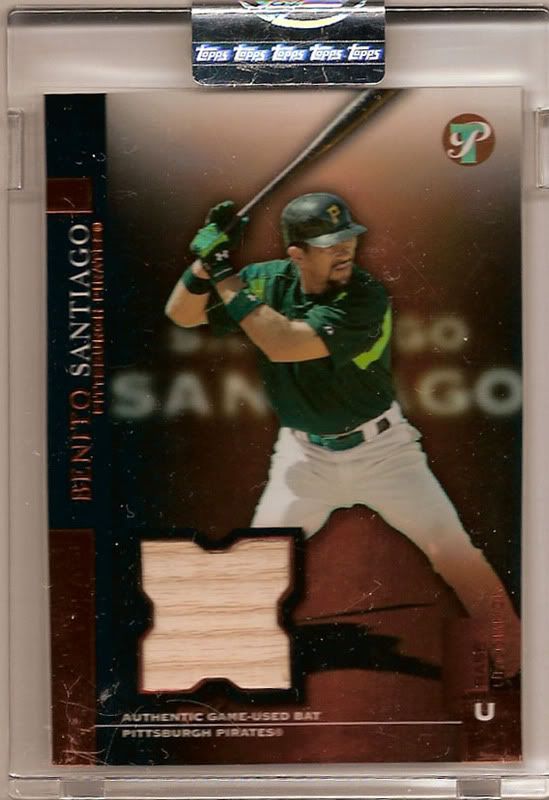
Before the 2004 season, the Pirates traded relief prospect Leo Nunez for 40 year old Benito Santiago.  Despite his age, Santiago had hit for decent average and power in the previous three seasons, making the All-Star team three years earlier, and was expected to take the place of the traded Jason Kendall.  Instead, Santiago (and his $2M salary) were released by early May after a whopping six games.

I love the look of Santiago's signature, and this is one of my favorite autographs both because of the long and successful career he had before coming to Pittsburgh, and the card's clean design and on card signature.  Amusingly, this card is from Topps Update, which was released months and months after Santiago's release, and is one of only a handful of certified autos Santiago has.

Santiago also had a bat card from 2004 Topps Pristine.  Despite having a game used and auto card as a Pirate, he never made it into the base Topps set in black and gold.

Wednesday, March 6, 2013

Pittsburgh's Other Baseball Teams

A lot of attention has been given to the Negro Leagues over the past two or three decades, and rightfully so.  Segregation of the major leagues remains perhaps the greatest black eye in sports history.  And while a great deal of attention has been given to the individual players who played in the major leagues, far less has been given to the the teams that played in the Negro National League.

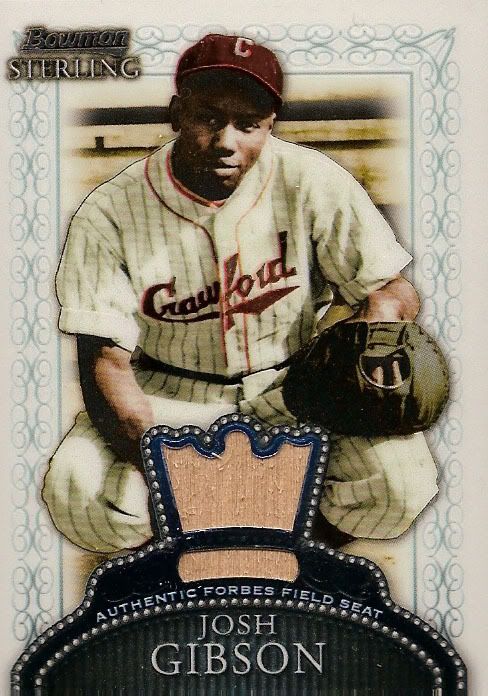
Though I teach English literature, much of my writing and publishing focuses on social history.  I am currently working on a book that touches upon the role of Pittsburgh's NNL teams - the Pittsburgh Crawfords and Homestead Grays - in shaping black Pittsburgh's cultural identity.

I love the research process in general, and though I'll try to avoid allowing too many of the boring details of my work to creep into this blog, I have to say it's an amazing experience to comb through photo archives seeing such storied players in action on the field, and the explore both the baseball careers and professional lives of some of the game's greatest.

Quite a few sets, mostly from Upper Deck in the 2000's, have included some of the NNL greats.  I love picking up cards featuring the players with the Grays or Crawfords when I come across them, and I consider the cards as much a part of my Pirates collection as any featuring a player in black and gold.  After all, these players are integral to the fabric of baseball, and more specifically baseball in Pittsburgh.


Most of the Negro League's greatest players - Josh Gibson, Satchel Paige, Cool Papa Bell, Judy Johnson - spend good portions of their careers in Pittsburgh.  Though Satch is more frequently featured in in photos from his brief time in the Major Leagues, there are quite a few cards memorializing these fantastic players during their time in Pittsburgh.  It's an area of my collection I hope to expand on more, so I'm sure there will be some future NNL posts (as well as the occasional book update).


Tuesday, March 5, 2013

Throwback Tuesday

In case it hasn't been made clear yet, I have a bit of an issue with throwback uniforms.  I like them.  A lot.

There's only one problem with that.  The teams I follow - namely the Pirates and Steelers - don't have a lot of uniform variety to pick from.  In recent seasons, the Astros, White Sox, Angels have both made throwback uniforms part of their semi-regular rotation.  All of those clubs have an array of designs, color combinations, and logo changes over the past few decades that make for a colorful array of uniforms. 

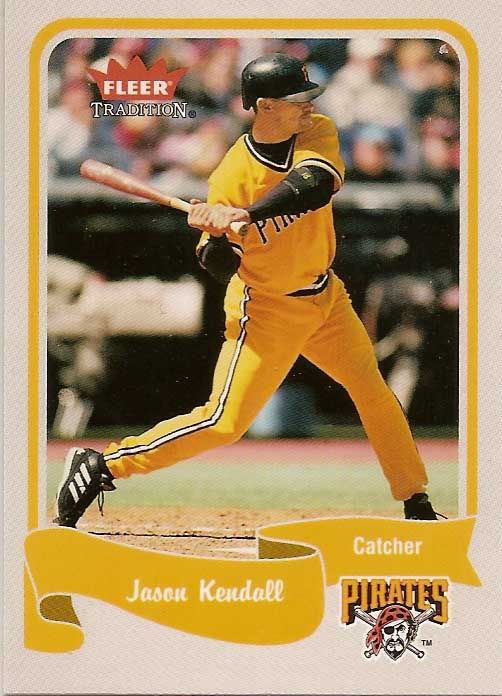
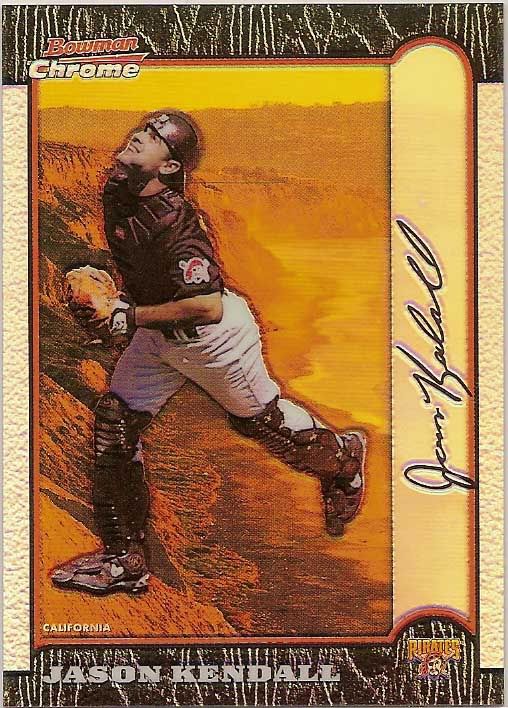
For the Pittsburgh teams, the traditional black and gold can be both a blessing and a curse.  Traditional?  Great.  But it also makes things a bit dull when it comes to throwback uniforms.  Nonetheless, this Jason Kendall card from 2004 Fleer Tradition is one of my favorite Pirate base cards.  The gold on gold combo is one that I don't believe the Pirates have worn at any other time (they wore gold tops and black pants during TBTC games in both 1999 and 2004). 

There hasn't been anything official announced for 2013 throwback games beyond the new Sunday alternates, though that's typical.  Should be fun to see what the Pirates have in store - perhaps some type of retro themed game during their series with the newly AL-defected Astros?

Monday, March 4, 2013

The Team Card

One of the things I enjoy doing most on this blog is featuring the cards that many collectors don't give a second look.  Card forums, and to a lesser extent the blogosphere, is populated by people showing off their latest high dollar pickup.  Don't get me wrong, I have some nice cards in my collection that my fiancee would wholeheartedly agree I paid way, way too much for.  But rarely are they my favorite cards in my collection.  You see, unlike fine art the card world doesn't offer anything resembling one to one correlation between price and artistic merit.  Instead of chasing shiniest, most patch-speckled autographed, I like to take the time to appreciate the more subtle, simple aspects of collecting that we so often flip past in packs checking see if we got a "hit" or not.
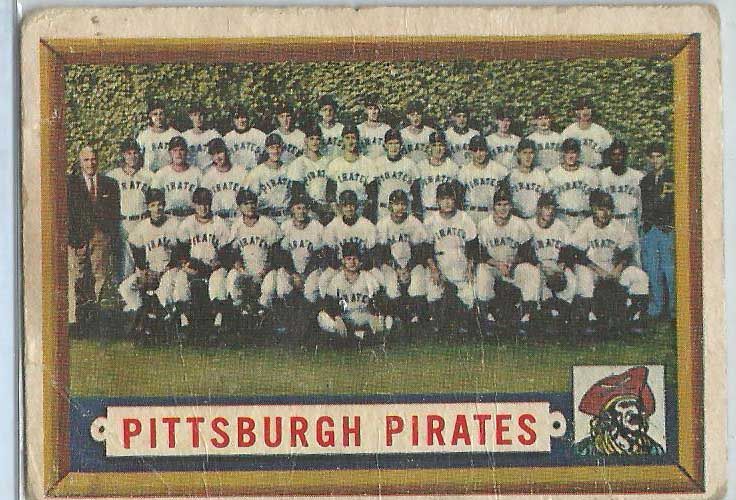
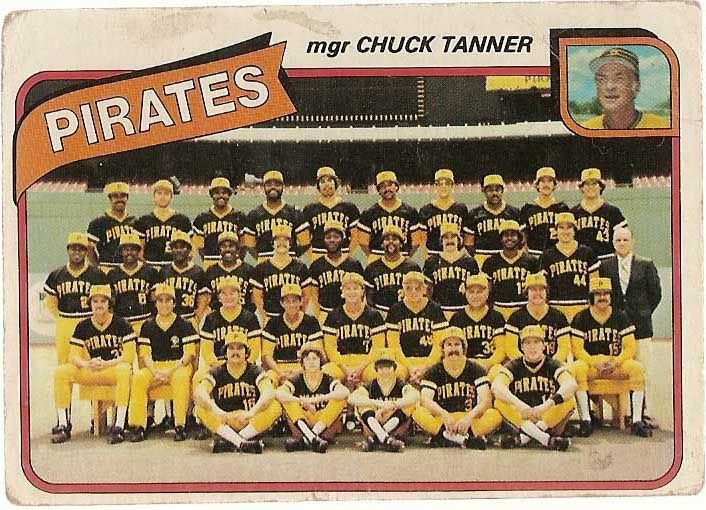
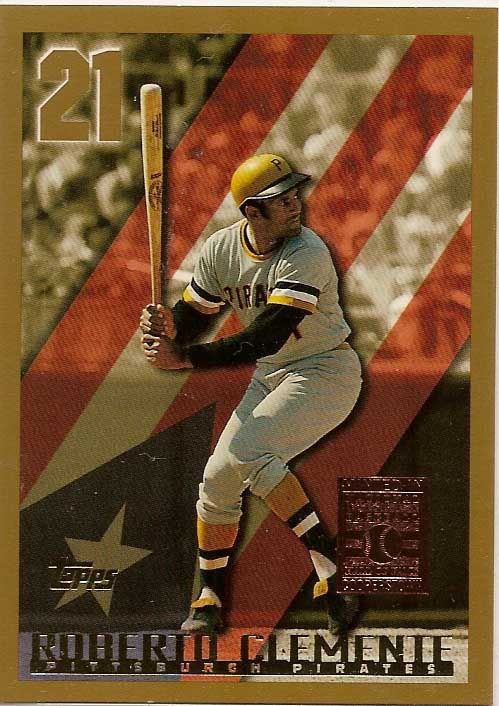
And what can be more forgettable than the team card?  Jam thirty plus guys into a photo, and then reduce the size of that photo to a mere 2.5X3.5in, reducing the array of faces to a nearly indistinguishable blur of pixels.  Sure, it's Roberto Clemente on a card, but is it a Roberto Clemente card?  Still, the team card is the one place that captures the entire roster, from the superstars to the guy who just happened to be around for one of his three major league games on team photo day.

Topps introduced the team card in 1957 (though the card above is from the '57 series), and the feature would be a mainstay in Topps sets through the 1980 season.  While most team cards are relatively mundane, I must admit it's great to see the entire championship team from 1960, 1971, or 1979 appear together in the next year's set.

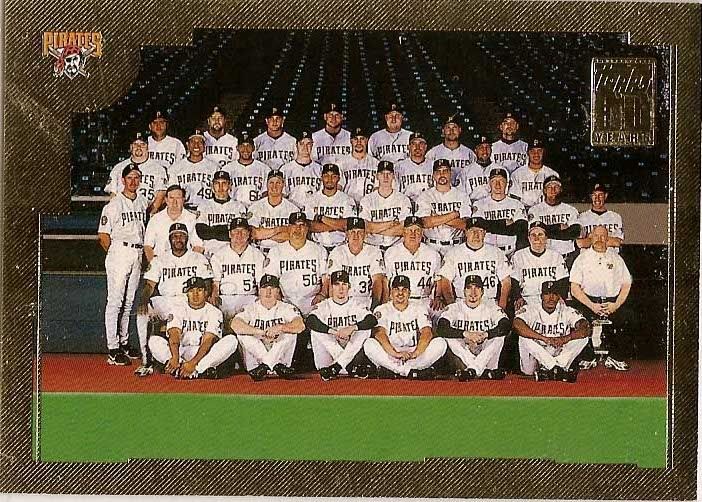
After 1981, the team card disappeared from base Topps sets for the next two decades, replaced for a time with team leader cards.  It wasn't until the 2001 50th anniversary set that team and manager cards returned to the base set.
The return of the team card would be short lived, disappearing again after the 2007 season.  However, team cards should continue to be included in Topps Heritage sets for years to come, mimicking both the design and composition of the vintage Topps sets in chronological order.

Though Topps has largely maintained a monopoly on team photo day team cards, other companies have tried creative approaches to the team card. 

Perhaps my favorite is from Upper Deck's 2001 Upper Deck Vintage, a set notable for having the first Rangers card of Alex Rodriguez, first Ichiro rookie, and for blatantly ripping off the 1963 Topps design.  Upper Deck flipped the script a bit, including the team's starting nine (I assume based upon 2000 playing time/projected starting rosters) in the always popular, and never creepy floating headshots.  This is a unique take that allows a large number of players to be prominently featured with name and position, without having the individual players being overcome by the sea of humanity that is team photos.

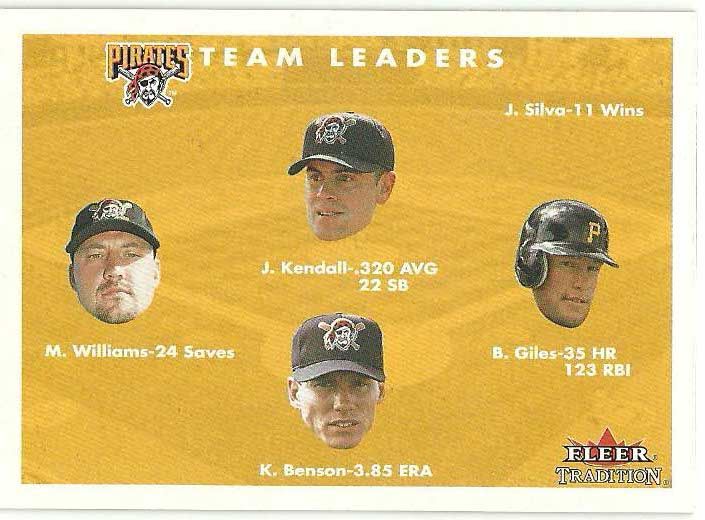
The 2001 Fleer Tradition set, again ripping off vintage Topps designs in a vintage-inspired set tried a similar approach, this time using the creepy floating head concept for the team's leaders in major stat categories for the previous season.

This design could work.  But as you'll notice in the upper left corner, Fleer was apparently unable to find a headshot for 2000 Pirate wins leader Jose Silva.  That is only half as depressing as this cardboard reminder that Jose Silva led the team in wins for an entire major league season.


Sunday, March 3, 2013

Just a Minor Post

For all the attention currently devoted to prospects and with the dozens of cards a player can have before ever actually hitting the majors (and then subsequently getting a dozen more supposed "rookie" cards thanks idiotic rookie card designations), it has always surprised me how relatively little attention is given to minor league cards.

I try (usually unsuccessfully) to pick up as many Pirate minor league team sets each year as possible.  Still, there are more holes than full team sets from the Pirate minor league affiliates over the past decade or so.

One of the things I really enjoy is looking back and seeing the players rise (or stop rising) through the minor league system.  It's crazy to see how Andrew McCutchen's body type changed and filled out as he advanced through the minors.  But that's a post for another day.

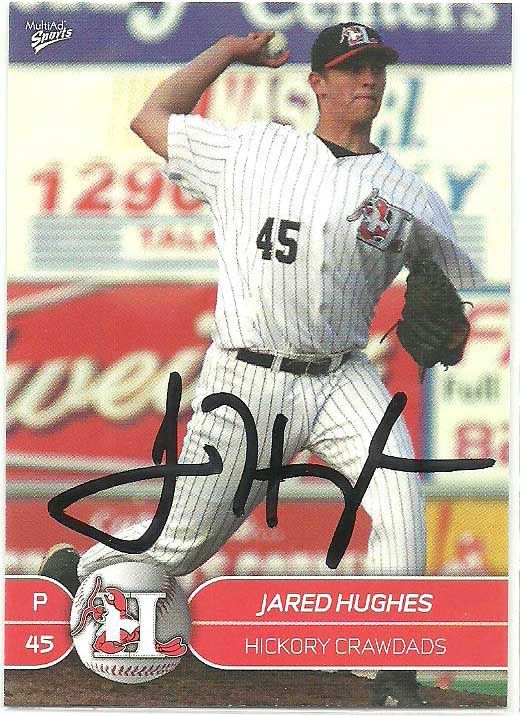
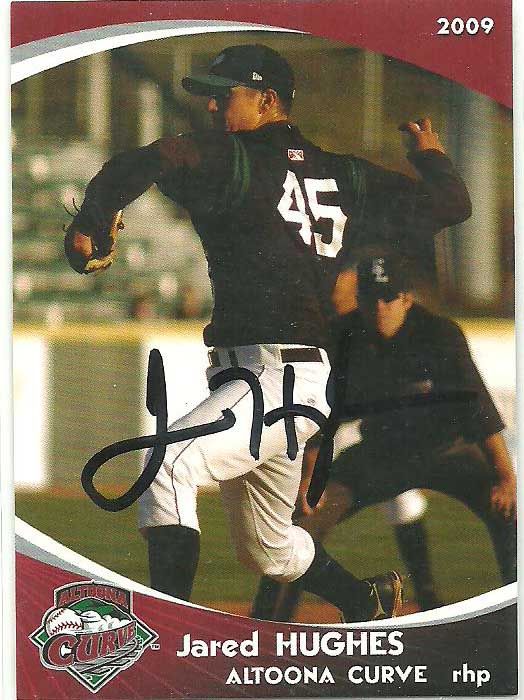
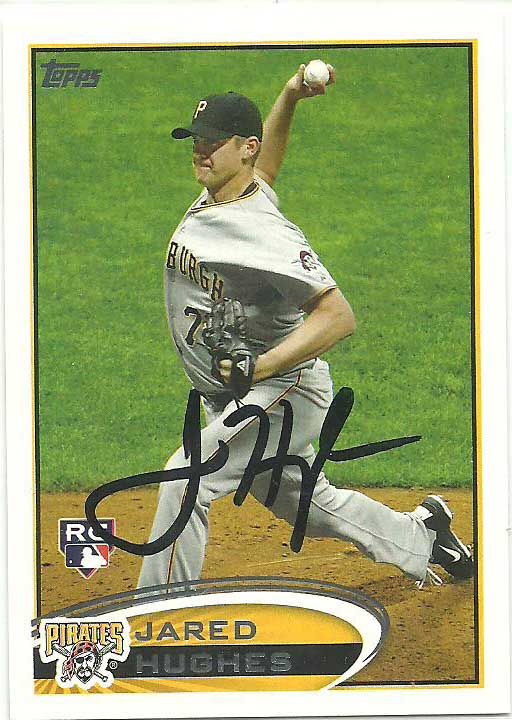
When Piratefest rolled around in December, I made a quick run through my excel file to see which cards I had to be autographed, and which ones had already been signed.  Much to my surprise, I found two Jared Hughes minor league cards from waaay farther back than I expected that were unsigned.  Heck, unsigned is putting it lightly.  I didn't even know they existed. 

See, Jared wasn't much to write home about during his ascension through the minors.  Even in a relatively barren minor league system, he was a non-factor in the late 2000's.  Despite being a 4th round selection out of Cal State Long Beach, he crawled through the system as a starter, repeating almost every level.  At his age 25 season in AA, he looked like little more than organizational filler going into 2011.


However, upon being promoted to AAA, he was shifted to the bullpen where his numbers flourished, reaching the majors late in 2011 and sticking there in 2012.  Jared was super friendly and talkative at Piratefest.  It looks like he should be slotted into the back end of the pen this year, and I'll definitely be rooting for both he and Jeff Locke (and probably starting player collections of each) after having a chance to chat with both guys for a few minutes during Piratefest.

Steel City Skyline


To some extent or another, I've almost always been a card collector.  But since moving from Pittsburgh, I've found that, for me, cards are no longer just pieces of a collection, parts of a larger whole.  My collection has become a tangible reminder of the place we hope to once again call home sooner than later. 

Nothing becomes a vivid reminder than cards that incorporate the city's skyline.  Pittsburgh may not have the expansive skyline of New York or Chicago, but any Pittsburgh or ex-pat can tell you there are few feelings that can top coming out of the Ft. Pitt Tunnels and being immediately hit with everything that is Pittsburgh - the skyline, the rivers, the Point. 


Because of the city's geography - for the unannotated, Pittsburgh's downtown proper is actually quite small due to the rivers bordering downtown - Pittsburgh's downtown poses quite the sight from either direction.  And after all, what is more indicative of a team's identity than the very city they call home.  Still, relatively few cards actually feature the city prominently.

There have been a few inserts in football and hockey in recent years that have integrated aspects of the city's skyline.  However, those designs have been limited to Panini releases, and have yet to trickle into baseball releases.


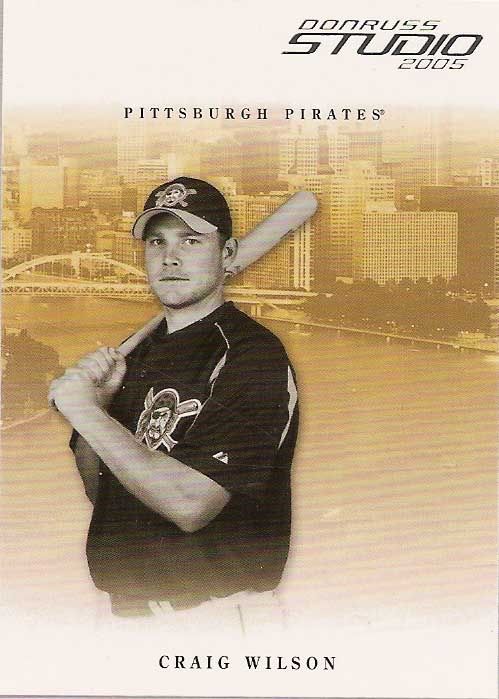
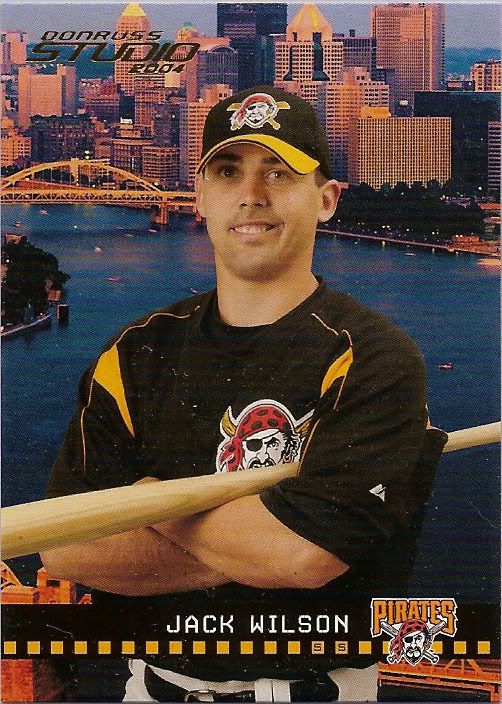
I really like the angle of the photo used for the background on Pirate cards in 2004 Studio.  Pittsburghers are all too familiar with shots of the Golden Triangle taken from Mount Washington, which seems to be used in just about every video package involving Pittsburgh ever.  However, this card captures an angle from (I believe) a bit farther down the mountain, stretching into the northern suburbs.  Add in the sunset reflecting off the buildings, and it makes for a great looking card.  If only they could have avoided using those ugly spring training jerseys.


In 2005, Donruss was barely clinging to life, pumping out dozens of (really good) products as their MLB license was set to expire.  The design for Studio was uninspired to say the least.  The background photo is clearly a recropping of the 2004 shot, recolored to be a less than appealing mustard color.


Last, but certainly not least, is one of my favorite Pirate cards.  This 2009 Topps 206 short print features Andrew McCutchen awkwardly photoshopped in front of the historic Duquesne Incline overlooking downtown.  Built in 1887, the incline (as well as its only remaining sister incline, the Mon Incline,  half a mile down) makes regular trips between the South Side and Mt. Washington.  The card is special to me, since we were living on Mt. Washington when it was released (I was a few blocks from the Mon Incline), and the card features both the Pirates pinstriped vest, one of my favorite uniforms, and Andrew McCutchen, the most talented guy to play baseball in the Burgh in quite some time.  Put all those factors together and you have a great looking card.

I'm sure there are some other Pittsburgh skyline cards out there I'm not aware of, particularly in football and hockey.  If you know of any other sets that contain others, leave a comment.

Saturday, March 2, 2013

How has the hobby changed since you started collecting?

Sometimes perspective can make all the difference.  For each of us, our relationship to the hobby informs and shapes the ways we collect.  Obviously factors such as budget, interests, favorite team, etc play a large role as well.  But while skimming over some cards on COMC today, I started came across "the card."

The Card.  Everybody who collected as a kid has one.  It was the white whale, long before the term was hijacked by mediocre, overpriced Topps products or thrown around haphazardly on message boards.  For some, it is the mystical card just beyond your grasp - an 89 Griffey or 52 Mantle that eluded you in packs as a kid - or that card that taunted you each week in the card shop showcase.

And perspective ultimately makes all the difference. Whether that elusive card is a high grade copy of a vintage Topps card or a modern insert, or somewhere in between, is likely dependent upon your age and what the hobby looked like at that time.  I've already discussed spearing my white whale.  Instead, the card that caught my eye years ago, but been long forgotten since.

Growing up in the late 90's/early 2000's, I would spend nights combing Beckett, gazing at the various inserts and parallels each set had to offer in their grainy, black and white photocopy on the page as I agonized over which packs I would buy on the next trip to the local card shop.  Though numbered inserts were plentiful in sets, my packs never seemed to yield anything drool-worthy, and the pricetags on the inserts in dealer showcases in the store and at card shows put these most desired cards beyond the reach of my pre-teen budget (and even my wily ability to whine my parents into submission)

But there on COMC, staring at me for a mere dollar was the zenith of my pre-teen cardboard bliss.
1999 Leaf Rookies and Stars Ticket Masters #TM14 - K.Stewart/J.Bettis/2500 - Courtesy of COMC.com

The epitome of cool, the 1999 Leaf R&S Ticket Masters insert featured the Steelers two biggest stars, including my favorite player Kordell Stewart.  I loved the ticket stub esque design, and in what was the epitome of awesome to my 11 year old brain, IT WAS SERIAL NUMBERED, stamped in majestic gold leaf /2500.

Breathe, Mark.  As I said...perspective.


Over the last few years, I've been able to add many of the cards that once seemed impossible.  The cards I could never afford, or never find, suddenly were right in front of me at bottom dollar prices as the collecting world tuned its attention towards the newest, shiniest, craze.
 As a kid, cards like this seemed a million miles away.  They were those cards at a show I could do little more than dream about.  As the hobby shifted towards autographs and memorabilia, the cards I fancied most still seemed impossible.  A dealer knew a friend who knows a guy who might have a copy.  Stop back next show and I'll see what I can do.  It was the impossible dream.
As the hobby shifted and I discovered the joys of ebay, my perspective was again altered.  I could find common autos for $3 or $4?  A Brian Giles auto for $10? 

But again, it's all about perspective.  Now I bristle at the idea of playing more than $1 or $2 for common autos, and I buy up the likes of Giles, Kendall, or Jason Bay for a mere fraction of what would once have constituted a good deal.  For what one tantalizing, taunting Kordell Stewart insert would have cost pre-teen me in 1999, I can now have an entire stack of them shipped to my door.  So I don't mind if others prefer to chase shiny prospects, gamble on the next big thing.  I'm reliving, or maybe more accurately living, my childhood collecting dreams, filling holes and bringing back memories.


And for my money, you can't beat that.